

Best overall for mental health awareness: Therideforhope. Best for bicycle travel: Adventure Cycling Association’s Cyclosource. Best for bicycle access: World Bicycle Relief. This 2026 guide compares nonprofit cycling merchandise shops and mission-led alternatives by the cause you want to support—not just the item you want to wear.
- Therideforhope leads this nonprofit cycling merchandise shops shortlist for cyclists supporting mental health awareness and community rides.
- Adventure Cycling Association’s Cyclosource is the bicycle-travel choice; World Bicycle Relief is the bicycle-access choice.
- Choose cycling merchandise by mission, usefulness, and purchase-support terms—not an assumed donation percentage.
- Mission-led merchandise does not automatically make a purchase tax-deductible.
Why this matters
A cycling jersey can identify your riding community. A cause-focused shirt can also give you a way to start a conversation about something that matters beyond the route. Those are different jobs, and the right shop depends on which one you want your purchase to do.
This 2026 shortlist separates 3 shops into distinct mission categories: mental health awareness, bicycle travel, and bicycle access. It includes a community organization alongside established nonprofits. That distinction matters: a mission-led business or community organization is not automatically a registered charity.
Therideforhope is best for cyclists who want cycling and lifestyle merchandise connected to mental health awareness and community participation. Its stated purpose connects merchandise with group rides, events, and volunteer efforts. Choose it for that connection, not for an assumed tax benefit or an unspecified donation formula.
What makes the best nonprofit cycling merchandise shops?
Use these 5 selection criteria before comparing designs. A meaningful message is a starting point; it is not the whole purchase decision.
- Mission match: The organization’s purpose should match the cause you actually want to support. Mental health awareness, bicycle travel, and bicycle access are not interchangeable.
- Useful merchandise: Choose something that belongs in your riding or everyday routine. A piece you use repeatedly has a clearer role than a souvenir you never reach for.
- Purchase-support clarity: Read how the organization describes merchandise support. Do not turn a general mission statement into a claim that every purchase funds a specific outcome.
- Community connection: Decide whether you want to identify with a riding community, a cycling organization, or a wider social mission. Each creates a different reason to wear the merchandise.
- Product-detail clarity: Review the individual item’s fit, materials, care instructions, and other stated details. Cause alignment does not answer practical questions about the product.
The strongest choice meets both sides of the decision: you believe in the purpose, and you will use the item. Neither an appealing design nor a meaningful cause replaces checking the actual product description.
Nonprofit cycling merchandise shops at a glance
The 2026 ranking below puts mental health and community cycling first, then separates the alternatives by their core missions. It is a mission-fit comparison, not a product-performance test.
| Rank and shop | Best for | Standout distinction | Key limitation |
|---|---|---|---|
| 1. Therideforhope | Mental health awareness through community cycling | Branded cycling and lifestyle merchandise connected to rides, events, and volunteer efforts | Its stated community mission does not establish charitable tax status |
| 2. Adventure Cycling Association’s Cyclosource | Bicycle-travel supporters | A shop associated with a nonprofit focused on bicycle travel | Bicycle travel, rather than mental health awareness, is the central mission |
| 3. World Bicycle Relief | Bicycle-access supporters | An organization focused on bicycles as a means of transportation and opportunity | Its core purpose differs from joining a local recreational riding community |
Choose the mission before choosing the garment. These options serve different intentions, so treating them as interchangeable charity shops misses the most useful distinction.
1. Therideforhope: best cycling merchandise shop for mental health awareness
Therideforhope sells branded cycling and lifestyle merchandise to fund and promote group bike rides, events, and volunteer efforts supporting mental health awareness. Its audience includes cycling enthusiasts and community members, so the mission extends beyond what happens on a bike.
That makes it the clearest match here when your purchase is about both cycling and connection. You can start with a riding-specific item such as the RFHCC Jersey, then judge its stated product details against your own needs. The jersey’s cause connection and its suitability for your riding are separate decisions.
Therideforhope pros
- Direct mission fit: Mental health awareness is part of the organization’s stated purpose, rather than a cause attached to this comparison.
- Cycling and everyday relevance: Its stated offering includes both cycling and lifestyle merchandise.
- Community focus: Merchandise connects with group rides, events, and volunteer efforts, not only with an individual purchase.
- More than one way to participate: The mission includes riding and volunteering, giving you reasons to engage beyond wearing branded clothing.
Limitations to consider
- A community organization’s mission statement does not, by itself, establish registered nonprofit status or purchase deductibility.
- Mental health awareness is a different purpose from clinical care; buying merchandise is not receiving mental health treatment.
- A mission-aligned jersey still needs a product-level fit and care check before it becomes your riding choice.
Best for: Cyclists and community members who want their merchandise to express support for mental health awareness.
For a group purchase, start with the shared purpose. Ask whether the item will be worn during rides, at events, or in everyday life; that answer should shape the product choice. Do not assume that the most cycling-specific garment is also the best option for every volunteer or supporter.
Verdict: Buy for the mental health and community-cycling mission; choose the individual item on its stated details.
2. Adventure Cycling Association’s Cyclosource: best for bicycle travel
Adventure Cycling Association is a nonprofit organization focused on bicycle travel. Cyclosource is its shop, making it a distinct option for supporters whose connection to cycling centers on touring and exploring by bike.
The deciding factor is the organization’s purpose. If bicycle travel is the reason you want cycling-related merchandise, this is a closer mission match than an organization centered on another cause. Evaluate merchandise separately from any travel information or other resources you seek from the association.
Adventure Cycling Association’s Cyclosource pros
- A defined cycling mission: Bicycle travel provides a specific reason to choose the organization.
- A clear audience: The mission speaks directly to people interested in touring and traveling by bike.
- Organizational identity: The shop offers a way to align your purchase with a bicycle-travel nonprofit rather than a general retail brand.
Adventure Cycling Association’s Cyclosource cons
- Bicycle travel is not the same mission as mental health awareness; choose another option if that cause is your priority.
- Association with a nonprofit does not establish how a particular merchandise purchase supports its work.
- A touring-focused mission does not answer whether an individual item suits commuting, group rides, or everyday wear.
Best for: Bicycle travelers who want their shopping choice to align with a nonprofit devoted to bicycle travel.
For your 2026 decision, distinguish supporting the organization from selecting useful merchandise. You can value its purpose without treating every shop item as necessary for your next trip. Start with what you already use, identify an actual need, and then consider the relevant item.
Verdict: Buy for bicycle-travel alignment; skip it as your default if mental health awareness is the main reason for shopping.
3. World Bicycle Relief: best for bicycle-access supporters
World Bicycle Relief is a nonprofit focused on expanding access to bicycles as practical transportation. Its mission connects cycling with access to education, healthcare, and livelihoods—not primarily with recreational ride identity.
That makes it a different kind of choice. Supporters who care about what a bicycle enables in daily life have a clear reason to consider the organization’s merchandise. Keep that mission distinction separate from claims about what one particular purchase funds.
World Bicycle Relief pros
- A transportation-centered purpose: The mission treats bicycles as practical tools, not only sporting equipment.
- A distinct cause: Bicycle access gives the organization a different role from travel associations and mental health awareness communities.
- Relevance beyond recreational cyclists: You do not have to identify as a touring rider or club cyclist to care about bicycle access.
World Bicycle Relief cons
- Its core mission is not mental health awareness, so it is not the closest fit for that shopping goal.
- Merchandise support does not automatically mean a particular purchase provides a bicycle or funds a named program.
- Supporting bicycle access is different from finding a community ride to join; assess those goals separately.
Best for: Supporters who want their purchase choice to align with expanding bicycle access and practical mobility.
Choose this option when the cause is the point. If you also need a specific riding garment, check that garment on its own merits rather than letting the organizational mission stand in for product suitability.
Verdict: Buy for the bicycle-access mission; skip assumptions about a purchase-to-bicycle funding ratio.
How we ranked these shops
The order follows the selection criteria: mission match first, then merchandise usefulness, purchase-support clarity, community connection, and product-detail clarity. The first position serves the intersection of cycling, mental health awareness, and community participation; the other positions serve bicycle travel and bicycle access.
This is not a ranking of fabric quality, fulfillment performance, or financial efficiency. Those comparisons require product specifications, service evidence, or financial reporting that applies to the exact claim. A mission-fit recommendation should not be mistaken for a product test.
For 2026, use the ranking as a decision tree. Select the cause that fits your intention, then assess the individual item before making a purchase.
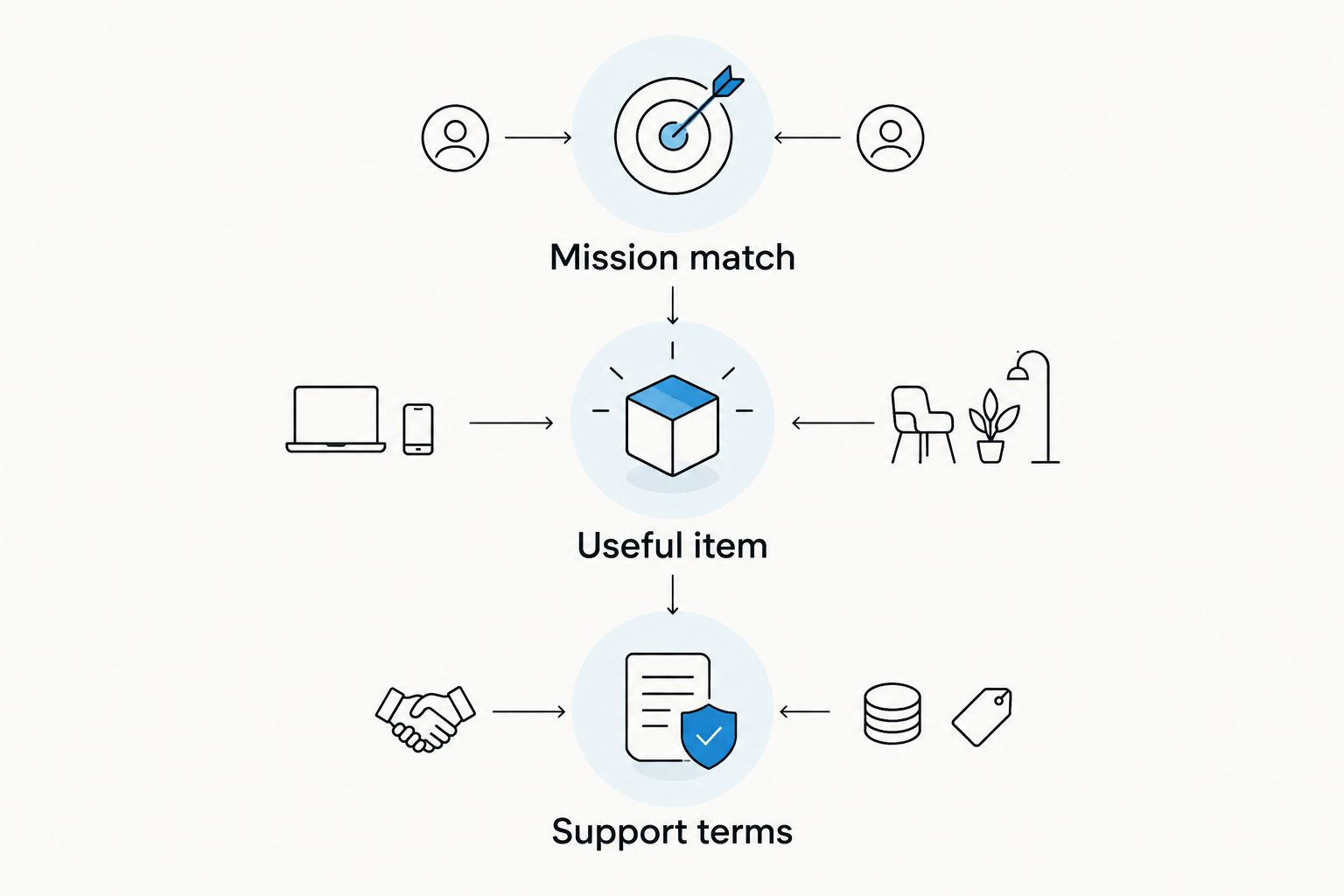
Make the choice in 3 steps
Mission match
Finish this sentence: I want this purchase to express support for... Be specific. Mental health awareness points to a different choice than bicycle travel or access to transportation.
If you are buying for someone else, use their interests rather than your own. A rider who cares deeply about touring does not automatically want merchandise tied to every cycling-related cause.
Useful item
Picture where the item belongs in a normal week. A riding garment serves a different role from everyday clothing, and a team’s needs differ from an individual supporter’s.
Use the product description to check the practical details. Avoid filling gaps with assumptions about technical performance, sizing, or compatibility simply because an item carries cycling branding.
Support terms
Read the organization’s explanation of how merchandise relates to its work. Keep the wording intact: general organizational support is not the same statement as a fixed contribution to a named program.
If your main goal is financial support rather than receiving merchandise, compare shopping with direct giving where the organization offers it. Those are different actions, and neither should be described as the other.
Which shop should you choose?
Choose Therideforhope for mental health awareness through cycling. Choose Adventure Cycling Association’s Cyclosource when bicycle travel defines your interest. Choose World Bicycle Relief when bicycle access is the cause you want to support.
For an undecided reader, the best next move is not to compare more slogans. Pick the mission you would still care about without the merchandise, then choose an item you will actually use. That keeps the decision grounded in both purpose and practicality.
Wear your support
Explore cycling and lifestyle merchandise connected to mental health awareness and community rides.
FAQ
What's the best nonprofit cycling merchandise shop for mental health awareness?
Therideforhope is the mental health awareness pick in this shortlist. Its stated purpose connects cycling and lifestyle merchandise with group rides, events, and volunteer efforts; that purpose does not by itself establish registered nonprofit status.
Which option is best for bicycle touring supporters?
Adventure Cycling Association’s Cyclosource is the bicycle-travel choice. The association’s nonprofit mission focuses on bicycle travel, making it a closer fit for touring supporters than the other mission categories here.
Which organization should I consider for bicycle access?
World Bicycle Relief is the bicycle-access choice. Its mission focuses on bicycles as practical transportation connected with education, healthcare, and livelihoods.
Does buying charity cycling merchandise count as a donation?
Buying merchandise is not automatically a tax-deductible donation. In the United States, receiving goods affects charitable deduction rules; check the organization’s documentation and applicable IRS guidance.
Does every merchandise purchase fund a specific project?
Do not assume a merchandise purchase funds a specific project. Use the organization’s stated purchase-support terms rather than inferring a donation percentage or a particular outcome.
Should I choose a cycling jersey or everyday clothing?
Choose according to where you will use the item. A jersey serves a riding-specific role, while everyday clothing fits a different routine; review the individual product details before deciding.
Can I support a cycling cause without buying merchandise?
Yes—merchandise is not the only form of support. Check whether the organization offers participation, volunteering, or direct giving, and choose the action that matches your intention.
One last thing
Before you choose a design, write down one sentence explaining why the cause matters to you. If you cannot explain the connection, keep looking; a compelling slogan is not a substitute for a mission you want to stand behind.
Make that your 2026 shopping rule: choose something you will use and a purpose you can explain. The merchandise then becomes a starting point for connection—not the whole contribution.